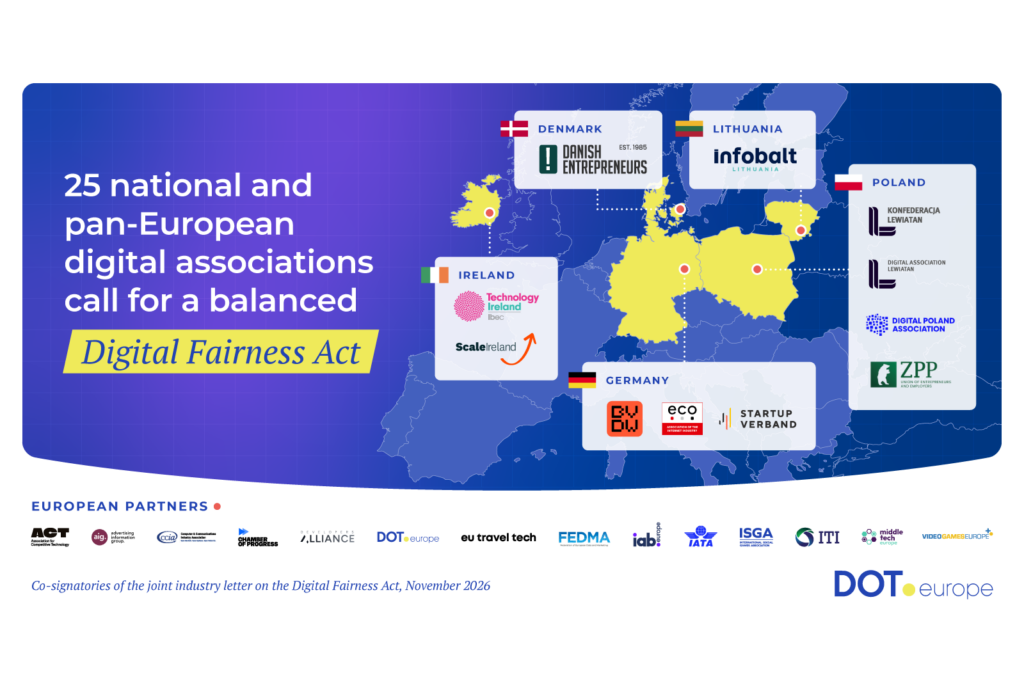
Brussels, 26 November 2026 – DOT Europe has joined ten other organisations representing businesses of all sizes across Europe’s digital economy in an open letter to President António Costa and the Members of the European Council. The letter sets out concerns about the proposed introduction of an EU-wide Digital Services Tax (DST) as a new own resource under the Multiannual Financial Framework (MFF) 2028–2034.
The proposal is a 3% levy on turnover, with global and EU thresholds of EUR 750 million and EUR 50 million. It would apply whether or not a service makes a profit, and on top of corporate income tax, the 15% global minimum tax and the national digital services taxes already in force in several Member States. The signatories warn that this risks double taxation and further fragmentation of the Single Market. It could also reignite trade tensions, with costs ultimately passed on to European SMEs, creators and consumers.
The letter asks the European Council to:
- Refrain from including a digital levy in the MFF agreement, and look instead at own resources with a broad, stable base that do not single out one sector.
- Keep any discussion on taxing the digital economy within the OECD/G20 Inclusive Framework, where the EU can help shape a global solution.
- Preserve open digital trade and work towards a coherent approach to existing national digital services taxes rather than adding a further layer.
José M Arroyo, Policy Manager at DOT Europe, said:
“While we understand Europe’s need to find new resources for the next budget, a tax on the turnover of digital services is the wrong place to look. It would tax the same activity several times over. Ultimately, the burden would fall on the SMEs, creators and consumers who rely on these services. We urge the European Council to leave it out of the MFF and keep this debate in the right forum: the OECD.”
Signatories
CCIA Europe – Computer & Communications Industry Association; Chamber of Progress; Danish Entrepreneurs; Digital Poland Association; DOT Europe; eco – Verband der Internetwirtschaft e.V.; EPIF – European Payment Institutions Federation; eu travel tech; ITI – Information Technology Industry Council; Startup-Verband (German Startup Association); Technology Ireland.