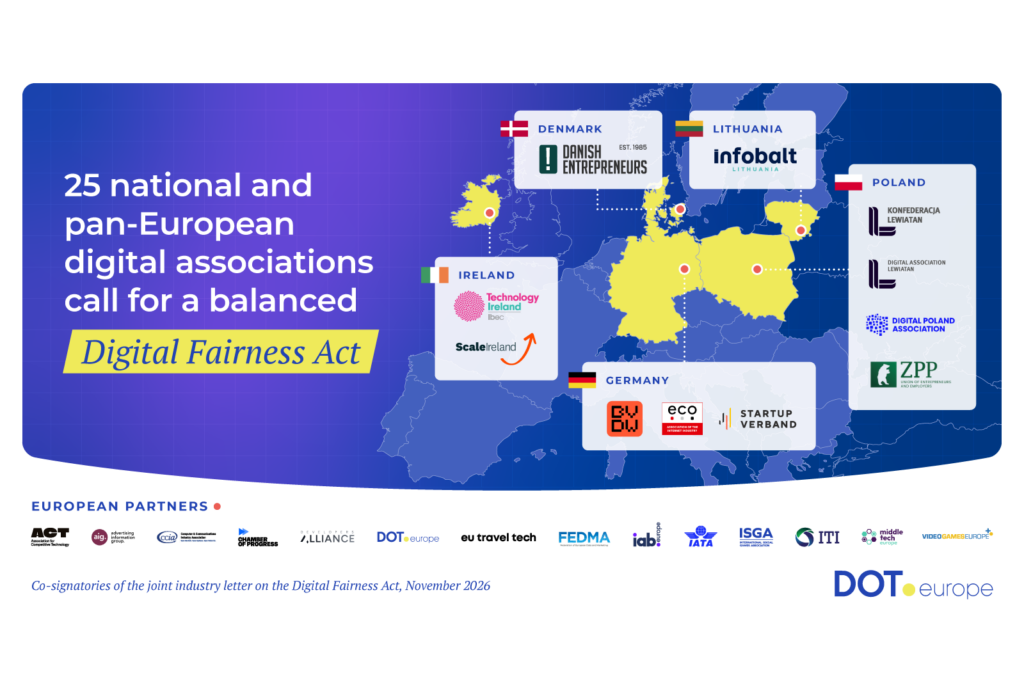
Brussels, 5 November 2026 – 22 organisations representing businesses of all sizes across Europe’s digital economy came together to call for a proportionate, evidence-based Digital Fairness Act, ahead of the Commission’s proposal on 11 November.
DOT Europe led this joint letter to make the case that consumer protection and competitiveness are not opposing goals. A Digital Fairness Act that is coherent with the existing rulebook and simple to apply can strike that balance.
The letter sets out four principles to guide the final proposal:
Competitiveness: an evidence-based, risk-based and technology-neutral approach that targets demonstrably harmful practices without restricting lawful business models or innovation that creates added value to the consumer.
Simplification: streamlining existing rules rather than adding new layers, especially for smaller companies.
Legal clarity: coherence with existing legislation like the DSA, DMA, AI Act, GDPR and the consumer acquis, many of which are still in their early years of application.
Enforcement: assessing and strengthening enforcement of existing rules, consistently and effectively, before adding new obligations.
Ben Brake, Director General of DOT Europe, said: “Consumer protection and competitiveness are not opposing goals. The Commission has committed to simplifying EU rules, and the Digital Fairness Act will be a test of that commitment. We believe it can deliver strong consumer protection without adding complexity, provided it is proportionate, coherent with the existing rulebook and grounded in evidence. Better enforcement of existing rules would be the strongest starting point.”
The signatories stand ready to work constructively with the Commission, the European Parliament and the Council towards a DFA that protects consumers and strengthens Europe’s digital economy.
06/11/2026 Update: 3 signatories added

